Geopolitical uncertainty and what it means for your investments
Geopolitical uncertainty is making headlines, but what does it really mean for your investments? Discover why markets are often more resilient than they seem, and learn practical steps to keep your portfolio strong through global shocks.
You’re not imagining it: the world may feel more uncertain than it was just a few years ago. Geopolitical risk indicators have been trending upward for over a decade, accelerating in the post-Covid era, where shocks have become particularly common.
Here at Schroders Personal Wealth, we’re often asked how these shocks affect our clients’ investments and portfolios. The good news is that, while the headlines can be daunting, financial markets can be resilient.
How does geopolitical uncertainty impact markets?
Geopolitical events often make waves in the financial world. In fact, if you chart the performance of global equities over time, you’ll likely be able to pinpoint some of the most pivotal events in recent history – the Global Financial Crisis, EU referendum, the outbreak of Covid-19 – based on how markets responded.
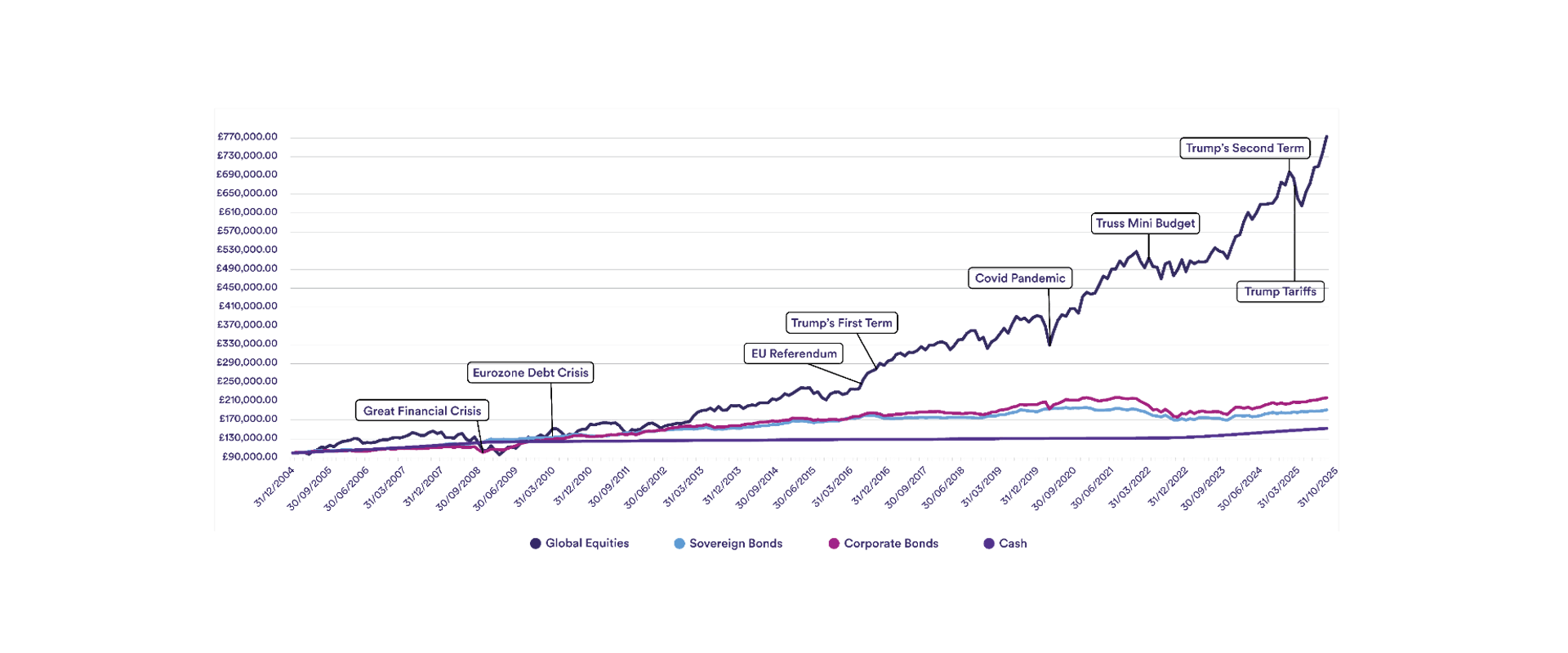
As a general rule, geopolitical uncertainty tends to trigger market volatility while calmer periods boost sentiment and markets. Importantly, these are both relative. For example, the start of a new government may feel uncertain, but both people and businesses alike appreciate knowing who is likely to be in power for the next five years.
Geopolitics influence financial markets for two broad reasons:
- Economic disruption is the tangible economic impact of a particular event. For example, new tariffs or an outbreak of conflict can limit a company's access to the materials it needs to produce its goods and services, which may harm its financial performance.
- Market sentiment is less tangible, referring to the emotional reaction many people have to geopolitical events. If people are worried about the current environment, they may make changes such as pulling out of the stock market, whereas if they feel confident they may choose to increase their investments.
Think about these two factors on a large scale. The behaviour of a single company or person will probably have little to no impact on the broader financial market. However, if many companies and people are affected or react in similar ways, it can cause significant changes to asset prices.
This is all important to understand, but here’s the most important part: geopolitical events typically cause short-term market volatility, and markets tend to be resilient over the long term. While your investments may experience price fluctuations soon after a worrying headline, historical data shows these dips tend to recover over time, particularly for well-constructed, diversified portfolios. However, past performance is not a reliable indicator of future results.
It’s also important to note that even some of the most newsworthy events don’t make as much as of a market splash as you might expect. For example, the recent changes in government in Venezuela has had a limited impact on equity markets and even oil prices so far.
“Periods of market volatility can feel uncomfortable, but history shows that remaining invested through uncertainty is often far more rewarding than trying to time the market,” says Alan Goodman, Chief Investment Officer at Schroders Personal Wealth. “Investors who stay focused on their long-term objectives are typically better placed to benefit when markets recover.”
How to mitigate geopolitical risk in your portfolio
While the market impacts of geopolitics are usually short-lived, there are things we can do to build resilience into your portfolio.
1.Maintain a long-term focus
Avoid making impulsive decisions based on what you read in the news. Remember, markets tend to be resilient over the long term, so pulling out during a downturn can mean you don’t benefit from a potential recovery.
Staying focused on your long-term goals is often the most effective response to short-term uncertainty.
2.Diversify your investments
Some assets are more volatile than others. For example, government bonds are considered relatively stable, while cryptocurrencies are considered relatively volatile. Additionally, assets react differently to events based on how exposed they are.
This means diversifying across asset classes, sectors and geographies can be a powerful way to buffer against geopolitical uncertainty. While some areas of your portfolio may be exposed to a shock, the others may not be, helping to improve overall resilience.
This table demonstrates the key benefit of diversification. It shows how different asset classes have performed over a number of years in percentage terms. You’ll see that no single asset class consistently comes out on top. This highlights how difficult it is to forecast which asset class will perform best in the future.
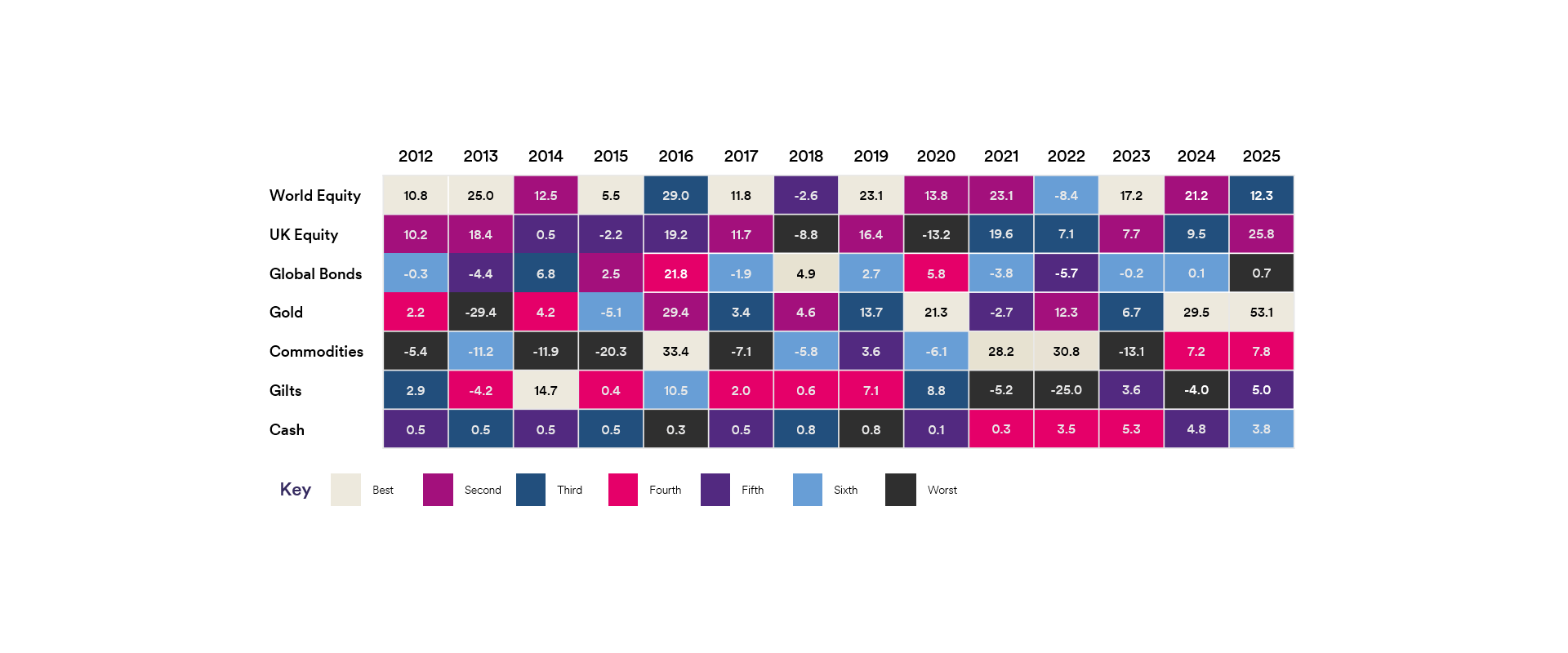
This is why, at Schroders Personal Wealth, we believe that by holding a range of investments, you are not exposed to one single type of asset therefore your investment risk may be reduced.
The mix of assets that are appropriate to you will depend on your individual circumstances and your financial goals. A good financial adviser can offer insights into which blend of investments could potentially be right for you based on your financial planning needs.
3.Make sure you have liquidity
The reality is that you are probably investing your money to grow and use it, which means it needs to be structured in a way that supports your financial goals.
Consider splitting your investments into different groups based on how you plan to use them: emergency, short-term, medium-term and long-term savings. The longer your savings are invested, the more time they have to recover from a shock. By contrast, your emergency fund should always be accessible, regardless of what’s happening in the news that day.
While geopolitical uncertainty is likely to remain a feature of the global landscape, it doesn’t have to derail your financial plans. Our advisers are here to help you stay focused on what matters most – your goals – whatever the headlines may bring.
Important information
This article is for information purposes only. It is not intended as investment advice.
Fees and charges apply.
The value of investments and the income from them can fall as well as rise and are not guaranteed, and so you might not get back your initial investment.
Any views expressed are our in-house views at the time of publishing. This content may not be used, copied, quoted, circulated or otherwise disclosed (in whole or in part) without our prior written consent.