How does cash perform over time compared to investments and inflation?
Curious about how your money could grow over time? Discover how cash, investments, and inflation have performed over the past 20 years. Learn why investing, even cautiously, could help your money grow and help to protect its value against rising prices.
When it comes to managing your finances, one of the most important decisions is how to allocate your money between cash savings and investments. Many people instinctively feel that holding cash is the safest option, especially during uncertain times. However, the long-term performance of cash compared to investments, and the impact of inflation, tells a more nuanced story.
Let’s explore how cash, investments, and inflation have performed over the past two decades, using real data from Schroders Personal Wealth’s Personal Discretionary Portfolio Service (PDPS) investment strategies, cash rates, and inflation figures.
The long-term picture
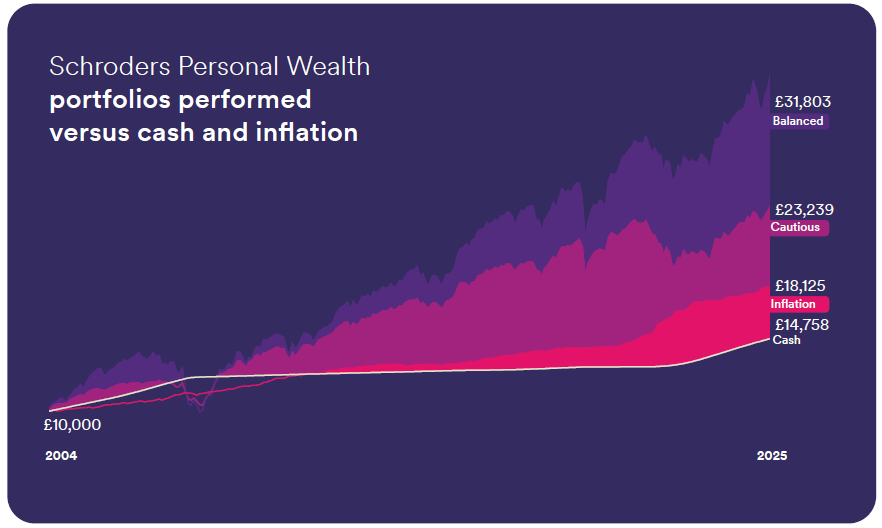
Imagine you had £10,000 to set aside in 2004. What would that money be worth today if you had kept it in cash, invested it in a cautious or balanced portfolio, or simply tracked inflation?
- Cash: Your £10,000 would have grown to £14,758.
- Inflation: To keep up with the rising cost of living, you would need £18,125.
- Cautious portfolio: Investing in a cautious portfolio would have grown your money to £23,239.
- Balanced portfolio: A balanced portfolio would have increased your wealth to £31,803.
This comparison highlights a crucial point: while cash savings do grow over time, they may often fail to keep pace with inflation, meaning your money may lose purchasing power. Investments, even those with a cautious approach, have historically outperformed both cash and inflation over the long term. However, its important to remember there is more risk associated with investing, the value can rise as well as fall and you may get back less than you invested.
The impact of inflation
Inflation is often called the “silent thief” because it gradually erodes the value of your money. If your cash savings do not grow at least as fast as inflation, you lose purchasing power. For example, while £10,000 in cash grew to £14,758 over 21 years, the cost of goods and services (as measured by inflation) rose to £18,125. In other words, your cash savings may buy you less in 2025 than they did in 2004.
Understanding the potential benefits of investing versus holding cash
Investments, such as those in cautious or balanced portfolios, typically include a mix of assets like shares, bonds, and property. These assets have the potential to generate higher returns than cash savings, especially over the long term. While they do carry more risk and can fluctuate in value, history shows that they have rewarded investors who stay the course. But it’s important to recognise that past performance is not a reliable indicator of future performance.
For example, the balanced portfolio in the data set used for the graph above grew to more than double the value of cash over the same period. Even the cautious portfolio, designed for those with a lower risk appetite, outpaced both cash and inflation.
What about short-term volatility?
It’s natural to worry about the ups and downs of investment markets. The data shows that there are years when investments lose value, while cash remains steady. However, focusing solely on short-term performance can lead to missed opportunities for long-term growth.
A well-diversified investment portfolio is designed to weather market volatility and deliver growth over time. The key is to align your investment strategy with your goals, time horizon, your desire to accept risk, and your capacity to tolerate losses.
Making your money work harder
Holding cash for emergencies and short-term (typically within the next 5 years) needs is sensible. But for long-term goals, such as retirement, supporting family, or building wealth, investing may offer the potential to grow your money faster than inflation and cash savings alone.
Investments have the potential to deliver higher returns than cash and offer some protection against inflation over time. But results can vary depending on market conditions and your time horizon. Working with a financial adviser can help you make informed choices.
Source
Factset, LSEG Datastream 31 August 2025. PDPS performance prior to 1 June 2019 reflects the Investment Portfolio Service managed by Lloyds bank plc. Returns are net of underlying fund fees and charges and gross of SPW fees. Cash is represented SONIA Overnight rates; inflation is represented by the Consumer Price Index (CPI).
The figures provided refer to the past and past performance is not a reliable indicator of future results.
Important information
This article is for information purposes only. It is not intended as investment advice.
Any views expressed are our in-house views as at the time of publishing.
This content may not be used, copied, quoted, circulated or otherwise disclosed (in whole or part) without our prior written consent.
The value of investments and the income from them can fall as well as rise and are not guaranteed. Investors might not get back their initial investment.
There is no guarantee by investing money it will keep level or beat inflation, particularly when inflation is high.
Cash savings and investments are protected to the value of £120,000 and £85,000 respectively, per person per institution by the Financial Services Compensation Scheme (FSCS). However, the value of investments may fall as well as rise.