Making the most of market highs without losing sight of your financial future
With markets conditions currently unpredictable and speculation around the Autumn Budget, you may be considering reviewing your financial plans. While taking tax-free cash may seem tempting, it’s important to stay focused on long-term goals, remembering markets are always unpredictable, avoid reactive decisions, and seek expert advice to ensure your financial plans remain on track.
With market conditions remaining unpredictable and speculation building around the Autumn Budget, you may be thinking about your financial plans. In times like these, when markets have risen considerably and confidence runs high despite economic uncertainty, it’s easy to feel tempted by short-term options like taking tax-free cash (TFC). But staying focused on your long-term goals, avoiding knee-jerk decisions, and seeking expert advice could help ensure your money continues working hard for you.
What the press is saying
Recent speculation suggested Chancellor Rachel Reeves might reform pension lump‑sum rules, potentially capping the amount of tax‑free cash available at retirement. However, currently press articles have appeared which seem to suggest otherwise; and that she is now intending to leaving the rules unchanged. Serving to show that current speculation is changing daily and in reality until 26th November and the day of the Budget, no-one knows for certain.
When headlines hint at possible changes to pension rules, and market movements create a sense of opportunity, it can feel like the perfect moment to act. But before making any decisions, it’s worth pausing to consider the bigger picture.
Why taking tax-free cash might still seem appealing
Even with this apparent change of heart, there are a few reasons why withdrawing TFC might feel appealing, but no-one should act without understanding the number of risks involved:
- Market highs: if investment values are up, you may be keen to “lock in” gains and take advantage of recent performance.
- Budget uncertainty: Speculation around the Autumn Budget has raised speculation about potential changes to pension allowances or tax treatment.
- Immediate needs: Whether it’s helping children onto the property ladder, paying off debt, or topping up ISAs, having access to cash can be tempting.
These are all valid considerations. But it’s important to remember that decisions made in response to short-term events can have long-term consequences.
The risks of acting too quickly
While it’s natural to want to protect your finances, reacting to market movements or political speculation could lead to missed opportunities, or even unintended consequences.
- Tax implications: Taking tax-free cash early could push you into a higher tax bracket, especially if you also start drawing an income from your pension. You might also trigger emergency tax, meaning you receive less than expected. And once you start taking taxable income, the Money Purchase Annual Allowance (MPAA) may apply—reducing how much you can contribute to your pension each year from £60,000 (depending on individual circumstances) to just £10,000. This could be particularly limiting if you're still working and want to continue building your pension savings.
- Impact on benefits: Taking money from your pension could affect current or future entitlement to means-tested benefits, which may not be immediately obvious without going through a full advice process.
- Loss of growth potential: Money withdrawn from your pension stops benefiting from tax-free compound growth and investment returns, which could affect your ability to meet long-term financial goals.
- Emotional decision-making: Acting out of fear or urgency could lead to choices that don’t align with your long-term goals.
- Irreversible decisions: Once funds are withdrawn, it may be difficult or impossible to put them back. Rules around Pension Commencement Lump Sum (PCLS) and tax free cash recycling, annual allowance limits, and relevant earnings can restrict future contributions.
- Delays without advice: Choosing a non-advised route may take longer to process due to increased regulatory requirements, and could mean missing out on tailored advice that considers your full financial picture.
- Overlooked services: If you have access to our Ongoing Advice Service (OAS), it’s worth reviewing whether it’s still suitable and being fully utilised, especially if you're paying for it.
- Unidentified risks: There may be additional risks that only come to light through a personalised advice process, so it’s always worth speaking to a financial adviser before making any decisions.
It’s worth noting that the Autumn Budget may introduce changes that affect some of these rules and allowances, so staying informed and seeking timely advice is key. Careful consideration of available options and planning are essential before taking action.
Investors with pensions should prioritise building a well-diversified portfolio that can help mitigate the impact of market downturns, rather than trying to anticipate political decisions. A bear market can significantly affect retirement savings, sometimes more than changes driven by government policy. Before making a large withdrawal, such as taking tax-free cash, when markets are in bear territory, it’s important to consider that the remaining funds will need to work harder to recover any losses. Holding a sufficient amount of readily accessible cash for emergencies could also provide flexibility and reduce the need to sell investments at an unfavourable time.
What is a bear market?
A bear market is when the value of investments, such as shares, falls by 20% or more from recent highs and stays low for a while. It usually happens during times of economic uncertainty, when people feel less confident about the future and sell their investments. For pension savers, this can mean your retirement pot temporarily drops in value. While this can feel worrying, bear markets are a normal part of investing and markets have historically recovered over time. The key is to stay focused on your long-term goals rather than reacting to short-term dips.
The principles of successful investing
At times like this, it helps to revisit the fundamentals of good investing to help you grow your wealth over time.
- Long-term focus: Markets will always rise and fall, but staying invested through the ups and downs is may be the most effective strategy.
- Diversification: Spreading your investments across different types of assets helps reduce risk and smooth out returns.
- Active management: Having professionals monitor and adjust your portfolio means you’re not alone in navigating change.
These principles aren’t just theory, they’re the foundation of how we manage your money.
Why staying invested matters
Even when markets show signs of strength, they can still feel unpredictable, especially during periods of political or economic speculation. It’s easy to wonder whether now is the time to make a big change. But history shows that staying invested whilst sticking to a clear strategy is often the best way to achieve long-term success.
We don’t just react to headlines. Our approach is proactive and personalised, helping you make decisions that support your financial wellbeing for years to come. Whether it’s reviewing your pension strategy, planning for retirement, or exploring gifting options, we’re here to offer advice based on your individual circumstances.
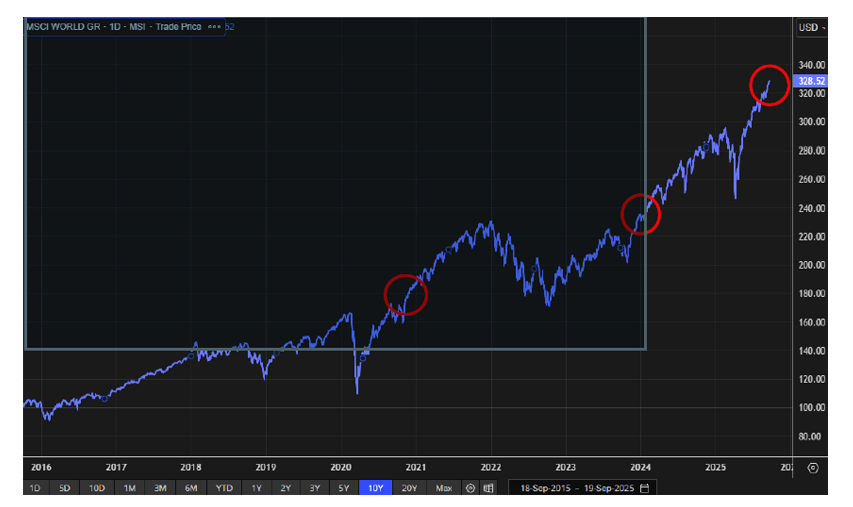
Take a look at the chart below. It shows global stock market performance over the past decade. Notice the points circled in red? Each one marks a time when the market hit a new high. At those moments, many investors felt uncertain and tried to predict what would happen next. But as you can see, calling the “top” of the market is incredibly difficult. Those who stayed invested through the ups and downs would likely have been rewarded over time.
The lesson? Short-term predictions are rarely reliable. A disciplined, long-term approach offers you the best chance of reaching your goals.
Our advisers are already having conversations with clients about the Autumn Budget and what it might mean. And while no one can predict the future, we can help you prepare for it, with both confidence and clarity.
What should you do next?
While there has been recent discussion around tax-free cash rules, the situation remains uncertain and subject to change. If you’re considering taking tax-free cash or making decisions based on speculation about the Autumn Budget, it’s important to proceed with caution. Speaking with your adviser first can help you understand the potential implications. Together, you can explore:
- Whether it fits with your overall financial plan
- The potential tax and investment implications
- Alternative ways to meet your goals without compromising future potential growth
It’s natural to feel uncertain when things are changing. But making financial decisions based on short-term concerns can often lead to long-term regret. By staying focused on your goals, leaning on expert advice, and trusting in a well-managed investment strategy, you can feel confident that your money is working for you.
If you’d like to talk about your options or review your pension plan, please get in touch. We’re here to help.
Important information
This article is for information purposes only. It is not intended as advice.
Fees and charges apply.
The value of investments and the income from them can fall as well as rise and are not guaranteed. You might not get back your initial investment.
The retirement benefits you receive from your pension plan depend on a number of factors including the value of your plan when you decide to take your benefits which isn't guaranteed and can do down as well as up. The benefits of your plan could fall below the amount(s) paid in.
Tax treatment depends on your individual circumstances and may be subject to change in the future.
In preparing this article we have used third party sources which we believe to be true and accurate as at the date of writing but can give no assurances or warranty regarding the accuracy, currency or applicability of any of the contents in relation to specific situations and particular circumstances.
Any views expressed are our in-house views as at the time of publishing. This content may not be used, copied, quoted, circulated or otherwise disclosed (in whole or in part) without our prior written consent.