
Staying steady when markets are flying high
When markets are performing strongly, you may consider reviewing your plans. While it’s tempting to act, history shows that staying invested and focusing on long-term goals is key. Learn why timing the market is so difficult and how expert advice could help you stay on track.
Global stock markets have been hitting new highs, even as headlines warn of geopolitical tensions, rising government debt, and policy uncertainty. This may create a familiar dilemma: should you take profits, adjust your portfolio, or simply stay the course?
It’s a question worth asking — but the answer often lies in the fundamentals.
Markets are up, but what’s next?
When markets hit record highs, it’s easy to wonder whether now is the time to take profits or make big changes. But history shows that predicting what happens next is incredibly difficult. Market cycles are influenced by countless factors, from economic data to investor sentiment, and short-term moves can be unpredictable. That’s why the most effective approach is usually to stay focused on your long-term goals, rather than trying to time the market.
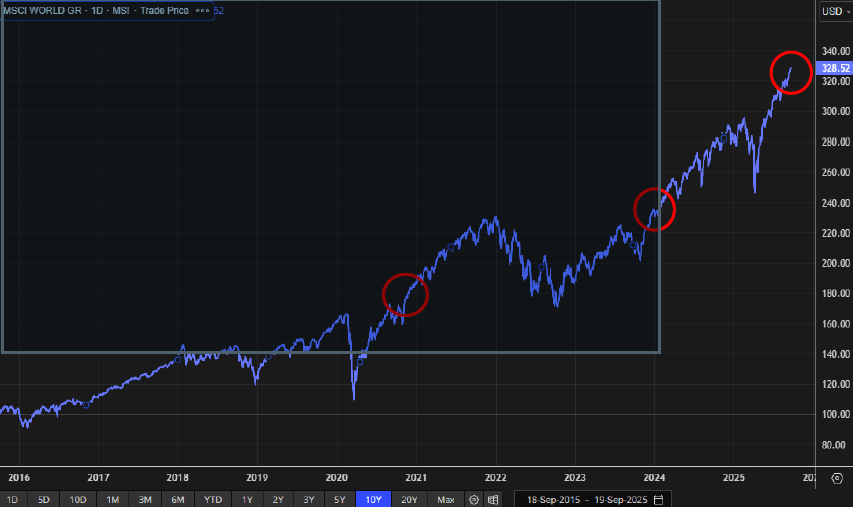
Take a look at the chart below. It shows global stock market performance over the past decade. Notice the points circled in red? Each one marks a time when the market hit a new high. At those moments, many investors felt uncertain and tried to predict what would happen next. But as you can see, calling the “top” of the market is incredibly difficult. Those who stayed invested through the ups and downs would likely have been rewarded over time.
The lesson? Short-term predictions are rarely reliable. A disciplined, long-term approach offers you the best chance of reaching your goals.
What’s behind the market highs?
Recent market strength has been driven by several factors, but one stands out: retail investor enthusiasm. Over the past 15 years, many individual investors have been “trained to buy every dip,” creating a fear of missing out rather than a focus on risk-adjusted returns. This behaviour contrasts with hedge funds and other institutional investors, which have been reducing positions and taking a more cautious approach.
That said, retail optimism hasn’t emerged in a vacuum. Economic indicators and corporate earnings have continued to positively surprise, reinforcing confidence and fuelling the rally. Still, this dynamic highlights an important point: strong markets can feel reassuring, but they can also encourage short-term thinking. The challenge is to avoid being swept up in momentum and instead keep your strategy aligned with your long-term goals.
Building resilience in your portfolio
Resilience isn’t about reacting to every market move, it’s about having a portfolio that can weather both rallies and downturns. At SPW, three core investment principles are key:
- Long-term focus: Short-term decisions often undermine long-term goals. Staying invested through market cycles is key to compounding growth. Learn more about why long-term investing matters
- Diversification: Spreading investments across different asset classes could help reduce risk and smooth returns. Discover the importance of diversification
- Active management: Markets change, and so should your portfolio. Active oversight aims to ensure that your investments adapt to evolving conditions.
These principles are the foundation of strong portfolio management and they’re central to how we work with clients.
Why strategy matters more than timing
Trying to call the top of the market is notoriously difficult. Even seasoned professionals rarely get it right. Instead of chasing short-term gains, focus on your long-term objectives.
This chart shows that if you missed the best 30 days between 2005 and 2025, your total return would have reduced from 385% to 40% and a reduction to 176% if you missed just the 10 best days. We believe it’s the “time in” the market that counts, not “timing” the market.
At SPW, our active approach means we’re constantly monitoring markets and adjusting portfolios where needed so you don’t have to make reactive decisions.
What you can do now
Strong markets are a great time to review your portfolio, not overhaul it. Here are some practical steps:
- Rebalance: Ensure your asset allocation still reflects your goals and risk tolerance.
- Diversify: Check that your portfolio isn’t overly concentrated in one sector or region.
- Explore opportunities: Consider whether new themes or strategies could strengthen your position.
- Stay prepared: Remember, staying invested doesn’t mean standing still. It means being thoughtful and proactive.
Your adviser can help you assess these areas and make adjustments where needed.
Confidence through clarity
Market highs can feel exciting, but they’re also a moment to pause and reflect. By prioritising resilience, leaning on expert advice, and not focusing on speculation, you can navigate uncertainty with confidence.
If you’d like to review your portfolio or discuss opportunities, get in touch with your adviser. We’re here to help you stay steady, whatever the market brings.
Important information
This article is for information purposes only. It is not intended as advice.
Fees and charges apply.
The value of investments and the income from them can fall as well as rise and are not guaranteed. You might not get back your initial investment.
Past performance is not a reliable indicator of future results.
Any views expressed are our in-house views as at the time of publishing.