The power of staying invested: Lessons from market history
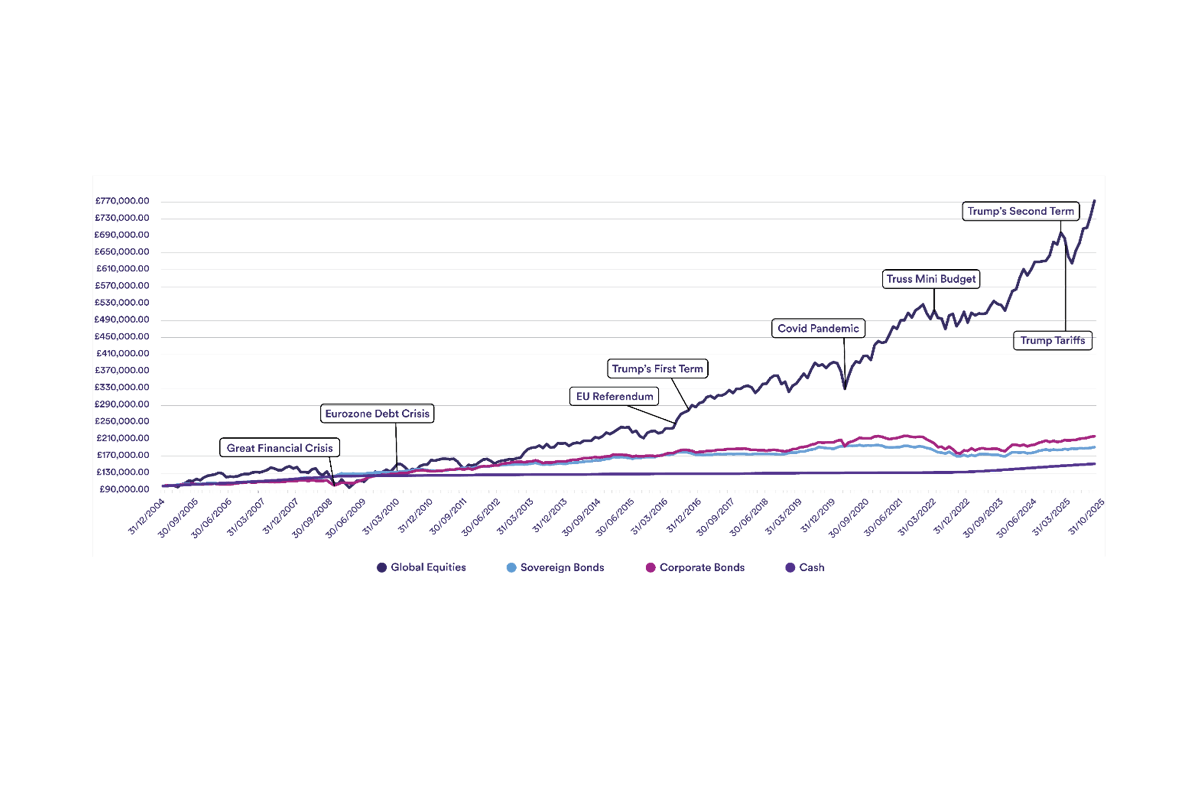
Market ups and downs can feel uncomfortable, but history shows that staying invested could be the route to long term potential growth. By remaining patient and following a clear plan, investors may be better placed to benefit when markets recover.
Periods of market uncertainty may prompt investors to question whether they should reduce their exposure to risk assets or step out of markets altogether. Reacting in this way is understandable. Human decision making is shaped by emotions such as fear and loss aversion, and volatile markets can intensify both. Yet history shows that remaining invested through challenging periods may potentially be an effective way to help to support growing wealth over the long term.
This principle isn’t based on optimism alone. It draws on decades of market data, behavioural research, and lessons from previous investment cycles. Although every period of volatility is different, there are patterns in how markets tend to behave over time and these can offer useful perspective.
Markets may reward patience
Over long periods, equity markets have delivered positive real returns many times over. These returns compensate investors for the uncertainty of holding assets whose prices can fluctuate. But even with this long-term evidence, past performance is not a reliable indicator of future performance and every investment journey is different.
A key point is that these long term results are rarely achieved through a smooth journey. Instead, they come from a combination of strong calendar years, muted years, and periods of negative returns that test conviction.
Investors who stay invested capture the full sequence, including the recoveries that often follow declines. Missing even a handful of the strongest market days could significantly reduce long term returns. Research that looks at global equity markets over the past several decades consistently shows that missing the best 90, 60, 30 or even 10 days, could lead to much lower final outcomes, even when the investor remains invested for the rest of the period.
These best days frequently cluster around the worst ones, making it extremely difficult to exit and re‑enter the market at the right points.
Remember that part of being a long‑term investor is accepting that markets will rise and fall. Because of this, returns aren’t guaranteed and you may not always get back the amount you started with.
Timing the market is harder than it looks
Market timing is the attempt to buy low and sell high by predicting short term movements. The idea sounds simple. The reality is that it requires two accurate decisions. The first is when to get out, and the second is when to get back in. Even professional investors find this challenging because short term market movements are influenced by countless variables that can change rapidly.
Economic data, company earnings announcements, elections, changes in interest rate expectations, geopolitical events, and investor sentiment all contribute to daily volatility. These factors can interact in unexpected ways. Markets often rise while headlines remain negative, or they can fall when the economic backdrop appears healthy. Because of this unpredictability, investors who attempt to time the market run the risk of reinvesting too late, once momentum has already returned.
Volatility is uncomfortable but normal
For investors with long term objectives, volatility is a feature of markets rather than a flaw. The price you pay for the potential to earn higher returns from equities is accepting that prices can move sharply over short periods. Fixed income securities and cash experience lower volatility but typically offer lower long term returns in exchange.
One way to frame volatility is to view it as temporary noise within a broader trend of long term growth. Looking back over market history, every major downturn has eventually been followed by a recovery. The timing and speed of these recoveries vary, but they are a fundamental part of how markets function. Declines may feel unusual in the moment, yet they are part of the normal rhythm of long term investing.
Diversification helps smooth the journey
Although staying invested is important, staying invested in a well-diversified portfolio has the potential to be even more powerful. Diversification means spreading investments across a range of asset classes, regions, and sectors so that no single exposure dominates overall performance. A diversified portfolio helps to reduce the risk that one event or theme can significantly derail long term plans.
In practice, diversification helps manage the emotional impact of short term market movements. When different parts of the portfolio respond differently to economic conditions, the combined result is typically less volatile than any single asset on its own. This can make it easier to remain invested during difficult periods and avoid decisions driven by short term emotions.
The importance of a financial plan
A thoughtful financial plan can act as a guide through periods of uncertainty. It aligns investment decisions with long term objectives, risk tolerance, time horizons, and capacity for losses. Having a plan in place means that short term events can be interpreted in the context of long term goals rather than as triggers for reactive decisions.
Market history teaches a clear lesson. While volatility is a natural part of investing, the sharp movements that feel most uncomfortable tend not to last forever. Markets have historically moved through these periods over time. Investors who remain patient, stay invested, and follow a disciplined plan are well positioned to benefit from future recoveries. Short term setbacks are an inevitable part of investing, but they do not define long term outcomes. A calm, consistent approach often proves to be the most powerful strategy of all.
Important information
This article is for information purposes only. It is not intended as investment advice.
Any views expressed are our in-house views at the time of publishing. This content may not be used, copied, quoted, circulated or otherwise disclosed (in whole or in part) without our prior written consent.
In preparing this article we have used third party sources which we believe to be true and accurate as at the date of writing but can give no assurances or warranty regarding the accuracy, currency or applicability of any of the contents in relation to specific situations and particular circumstances.